
Start Belmont Previous Residents with the Parcel
A house-history search is steadier when it starts with the current situs, the parcel's physical address, rather than a guessed former resident. Use Belmont's map hub, then the San Mateo County Property Maps and secured tax lookup to connect the address to an APN. That parcel number bridges maps, taxes, permits, and recorded instruments. It does not identify everyone who lived at the house.
| Source | Years It Covers | Where Held | What It Shows |
|---|---|---|---|
| RecorderWorks | 1985-present online | ACRE index | Parties, type, date, number |
| Earlier deeds | Pre-1985; start unknown online | Recorder counter, 555 County Center | Older transfers |
| Parcel maps | Current portal; map dates | County maps and Recorder | APN and subdivision continuity |
| Belmont directories | 1899, 1911-12, 1941-42, 1950, 1954; scattered 1927, 1945-46, 1948-49, 1955-56, 1968 | Libraries and local-history collections | Residents, addresses, occupations |
| Federal census | Public through 1950 | Federal archives and library databases | Household relationships |
| Belmont permits | Online start unpublished | eTRAKiT and Permit Center | Construction dates |
| Sanborn maps | 1913 reported; verify item | Library of Congress and local repositories | Footprint and use |
Choose the row that matches the period. RecorderWorks starts the modern title trail; directories, census schedules, permits, and maps add context. None is a complete roster, and a gap may reflect a missing volume or unindexed record.
Note: A missing directory entry narrows a search, but it does not prove a move, death, or vacant house.
Belmont Recorder Records Start Here
The APN and legal description make the deed search precise. The county map layer exposes APN and situs components, but the published GIS service does not promise a public owner-name directory. Obtain the current recorded owner through a lawful roll, counter, or title source, confirm the result, then move to the ACRE grantor-grantee search or RecorderWorks. The online index reaches 1985-present and is not a direct address search.
Choose All, Grantor, or Grantee; enter LAST FIRST, allow a partial match, set dates, or use Map mode with a nine-digit APN without dashes. Results can show parties, type, date, recording number, page count, and sometimes book/page. Narrow common names with APN, legal description, spouse, trust, or entity clues.
Images are omitted online for privacy. Metadata is a lead, not an ownership or occupancy opinion.
ACRE's grantor-grantee search shows the index entry point.
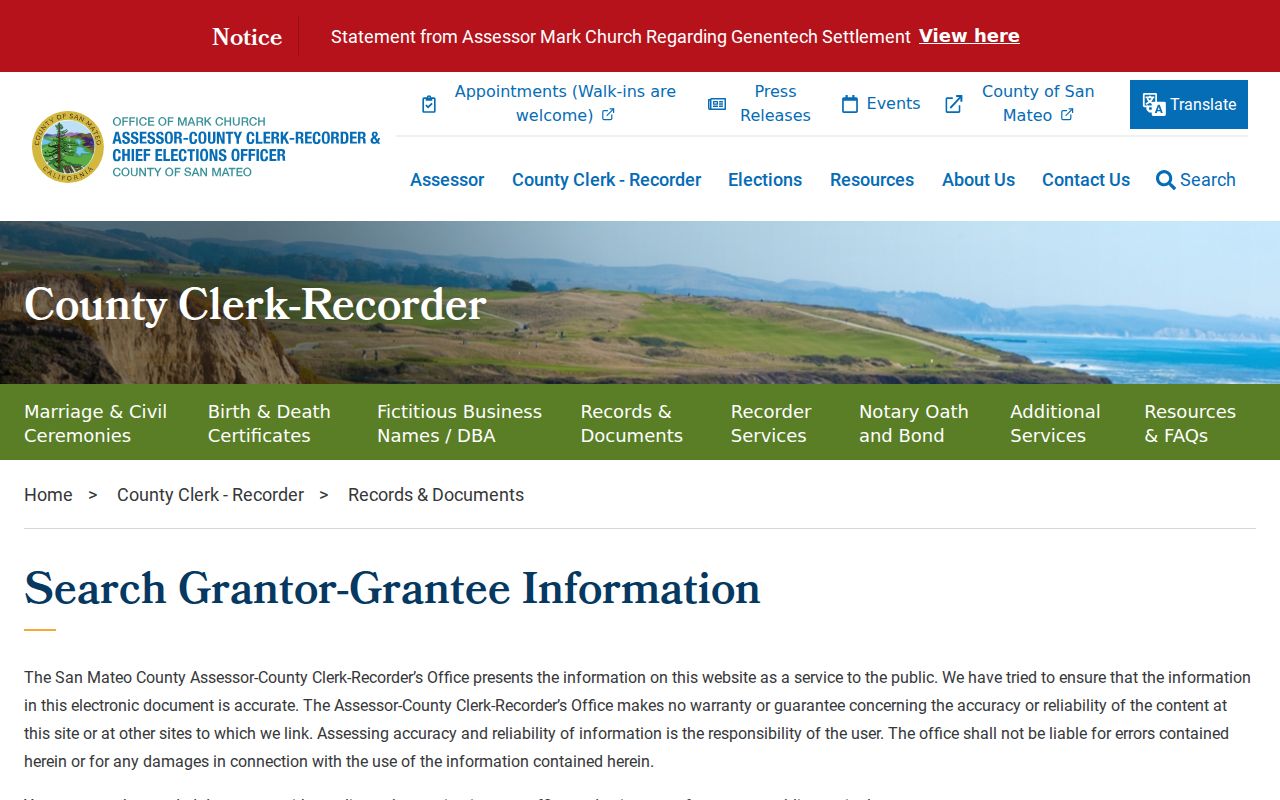
It locates an instrument, not people at an address.
Walk the Belmont Previous Residents Deed Trail
A chain of title moves from the current recorded owner to the prior transfer, one verified instrument at a time. Start with the situs, not a same-name shortcut. The acquisition seller is the next grantee to test. Ownership and occupancy differ.
- Normalize the situs in the Belmont or county map viewer. Record the APN, maps, lot, block, and subdivision.
- Establish the current recorded owner through the lawful roll, counter, or title source. Do not infer a name from a mailing address.
- Search that owner as grantee in RecorderWorks, using Name, partial match, dates, and entity, trust, or spouse variants.
- Compare the acquisition's date, type, APN, and legal description. The seller is the grantor.
- Search the seller as grantee and confirm dates, parcel references, legal description, and related parties.
- Repeat to 1985, then use Recorder terminals, grantor-grantee books, and deed books at 555 County Center.
This produces an ownership sequence, not an occupant list. A trust, estate, entity, or remote owner may appear in deeds; an occupant may appear in a directory, census, permit, newspaper, or family record.
- Grantor / grantee
- The grantor transfers an interest; the grantee receives it.
- Chain of title
- Recorded transfers linked to one parcel.
- Legal description
- Formal land identity, such as lot, block, or subdivision, used when street labels change.
- Criss-cross directory
- An address-first directory listing a number, subscriber, telephone, and nearby entries.
- Enumeration district
- The census area assigned to an enumerator.
Belmont Legal Records Cross Address Changes
Street text is a clue, but APN, lot, block, subdivision, and recorded-map references bridge time. County Property Maps accepts an address, nine-digit APN, assessor book/page, or parcel/subdivision map volume/page. Free downloads show adjoining parcels; the Recorder can provide an official printed map for a fee.
Old County Road aligns with present El Camino Real, while Cañada del Diablo roughly aligns with Ralston Avenue. No verified citywide renumbering year was located. Preserve an old number as written, then test it against the legal description and map.
Belmont Records Before the 1985 Cutoff
RecorderWorks has metadata from 1985-present, but no deed image. Earlier books require a counter search. ACRE places the Assessor on the third floor and Clerk-Recorder on the first floor at 555 County Center, Redwood City. Hours are Monday-Friday, 8 a.m.-5 p.m.; capacity affects walk-ins, and appointments are encouraged. Call 650-363-4500.
For a copy, record the parties, document type, date, and recording number. The ACRE copy instructions require a preprinted U.S. bank check, money order, or cashier's check payable to San Mateo County Clerk-Recorder and a self-addressed stamped envelope. Mail to ACRE, Attn: Customer Service Desk, 555 County Center, 1st Floor, Redwood City, CA 94063. Regular copies cost $5 first page plus $1 each additional; certification adds $5, and a conformed copy is $10.
Counter viewing is the fallback when the web record ends. Staff preserve records but do not conduct a title search. Compare the instrument with the parties and legal description.
The copy request page shows the mail channel.
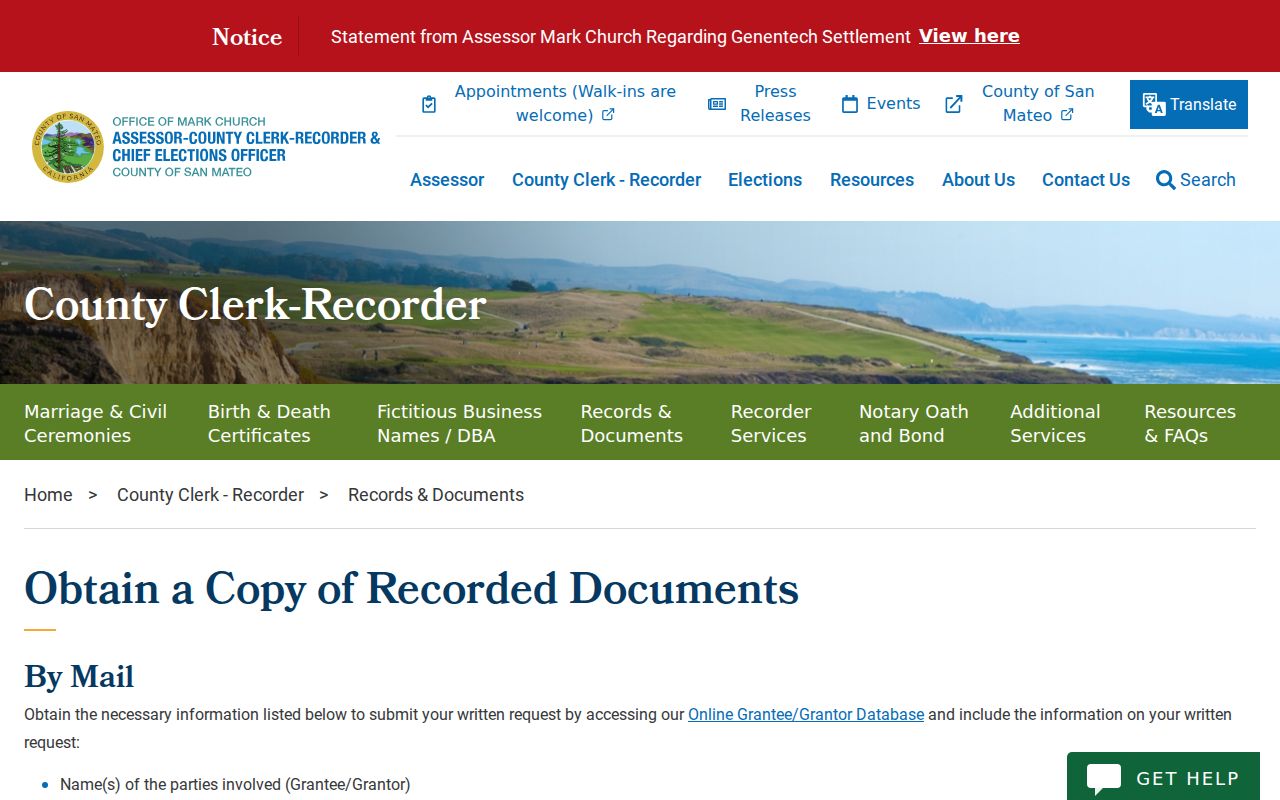
The copy can be checked against parties, dates, and legal description.
Counter advantage. Free in-office viewing can bridge the gap between the online 1985-present index and older books without treating a legacy portal hint as proof of earlier online coverage.
Belmont's Directory Years Find Households
Deeds identify recorded parties. Directories can add a spouse, occupation, address, or telephone subscriber. Belmont Library, 1110 Alameda de las Pulgas, offers genealogy referral. Listed hours are Monday-Thursday 10-8 and Friday-Sunday 10-5; access can depend on location or card status. The county library genealogy page is the online start.
The San Mateo Main Library California Collection, 55 W. Third Avenue, holds nearby directories from the 1900s-present, maps, Sanborn material, newspaper microfilm, and a 1940s-1960s clipping file. Reference: 650-522-7818. The Genealogical Society's Schellens Collection adds abstracts from directories, Great Registers, county books, histories, and newspapers.
The San Mateo County Historical Association Research Library holds about 1,400 books and roughly 30,000 photographs, plus maps, manuscripts, clippings, memorabilia, and newspapers. Confirm appointments and fees. Belmont's History Room is behind the Manor Building at 10 Twin Pines Lane, 650-654-4068. No official research-your-house guide was located, so ask these repositories by family, street, subdivision, or landmark.
Runs include a 1899 social directory, 1911-12 county directories, Polk's Redwood City volumes for 1941-42, 1950, and 1954, a 1948 telephone directory, and the 1954 Atherton & Belmont City Directory. Catalogs also show 1927, 1945-46, 1948-49, 1955-56, and 1968. Use the California State Library catalog and physical California Collection; no shelf list proves continuity, so verify each volume.
ACRE's recording FAQ distinguishes an index reference from a title opinion.
A directory clue suggests a household to test; the deed establishes the transaction.
Pair Belmont Resident Households with Census Dates
A directory surveys a particular time; it does not count everyone in a dwelling. Read the volume's key before interpreting “r,” “h,” “wid,” ownership marks, business addresses, or telephone conventions. Pair the closest directory and census dates so names, relationships, occupations, and addresses can be tested together.
- Search surname variants and copy the given name, spouse, occupation, address, and symbols exactly.
- Check a street or reverse section, when present, for the number, nearby subscribers, and a predecessor.
- Pair 1911-12 with the 1910 and 1920 census, 1941-42 with 1940, and 1948-1954 with 1950.
- Use household and enumeration-district details to test relationships at the census date. Schedules are public through 1950.
- Compare the next available volume. Appearance or disappearance is a clue, not a final event.
The broader collection belongs with the Belmont city directory collections. Record each volume's publication or canvass date beside the address claim. San Mateo Times microfilm, 1901 through March 1996, can add a dated obituary or community notice.
Note: Directories may omit children, people without telephones, nonparticipants, and households outside a publisher's geographic scope.
Belmont House Records: Maps and Permits
Physical evidence can explain a changed deed or directory address. Belmont's eTRAKiT search connects permits, projects, parcels, applicants, owners, contractors, and dates, but registration is required even for public searching and its online start year is unpublished. Older plans or inspections may require the Permit Center counter or a city records request.
Assessor and recorded subdivision maps can anchor a parcel split or adjoining lot. A Belmont 1913 Sanborn map is reported in catalogs, but the direct Library of Congress item needs verification. A permit applicant is a project clue, not a household roster.
Belmont's 1991 historic inventory counted 52 buildings and structures. Project history may be with the Belmont Historical Society, SMCHA, or Northwest Information Center, adding photographs and maps.
Old Belmont Names Hide Past Residents
Belmont's early land trail crosses several record geographies. It lay in San Francisco County until San Mateo County organized in 1856. A pre-1856 search may move through Rancho de las Pulgas, confirmation records, San Francisco County, and then San Mateo County deeds. The Mezes and Argüello claim was filed in 1851 and confirmed in 1853.
Search The Corners, Four Corners, Angelo's Corners, Waterview, and Flashner's Corners. Pair Old County Road with El Camino Real and Cañada del Diablo with Ralston Avenue. Preserve original wording and date, then confirm with APN, map, legal description, or a second source. Belmont incorporated in 1926, so older municipal evidence may be county material.
Close the Belmont Previous Residents Trail
When a directory entry ends, seek an event record rather than assuming a move or death. San Mateo Times microfilm can provide an obituary. Probate belongs to the San Mateo Superior Court Odyssey portals, with case limits. County Recorder and Clerk channels hold birth, death, and public-marriage copies; confidential marriages remain restricted. State forms provide certificates where allowed; a divorce decree comes from court.
Compare the last dated directory entry, deed, permit, obituary, probate file, or vital record. A person may vanish because the run was discontinuous, the household was not canvassed, or the name was indexed differently. State what the record proves.
The Recorder's title-search FAQ reinforces the distinction between a public index and a title opinion, which is the right final check for Belmont previous residents research.
Lawful house history. Previous-resident research in Belmont is appropriate for family history, house history, estate questions, archival curiosity, and personal reconnection. Do not use a record trail to stalk, harass, track, or harm a living person. A confidential or substitute address is a safety protection, not a gap to defeat.