
Starting a Belmont Residents Directory Search
A Belmont residents directory search works best as a sequence, not a single name query. An address can lead to a parcel and then to a recorded owner. A known name can lead to a court party, a license, a business filing, or a historical directory entry. None of those records means exactly the same thing. A voter status result belongs to the person who authenticates it, while a deed index names parties to an instrument. The county assessor and GIS tools provide land keys, the recorder supplies title metadata, and the libraries add household history.
Use the narrowest lawful path that fits the question. Start with a street or parcel when land is the subject. Start with a full name and date when the goal is identity. For an older household, keep the original spelling and search the historic place names used before Belmont became the stable label. A result becomes more useful when its date, record role, and custodian are written down beside it.
- Resolve the address in the county property map and note the APN, situs, and legal description.
- Check the appropriate county or state record, keeping owner, voter, party, and applicant roles separate.
- Use RecorderWorks for a deed or lien trail, then order or inspect the underlying document when needed.
- Compare the name and address with a court, license, business, vital, or directory source that fits the question.
- Ask the custodian through Belmont GovQA or the relevant counter when the public index does not contain the record.
That order prevents a common error: treating a single public entry as a complete household list. The county roll may identify an owner, but it does not list every person at a parcel. The historical shelf may show a subscriber, but it records a survey date rather than every occupant.
Belmont Resident Records Offices
Belmont’s record trail crosses city, county, court, and state lines. The city clerk is the first stop for minutes, ordinances, resolutions, contracts, commissions, and older municipal files. San Mateo County ACRE holds the assessor, recorder, county clerk, vital-record, and elections functions. The Superior Court holds case files. California departments keep statewide license, vital, custody, and business systems. Each office can describe its own records, but none is a master list of Belmont residents.
San Mateo County Recorder
555 County Center, 1st Floor
Redwood City, CA 94063
650-363-4500
San Mateo County Assessor
555 County Center, 3rd Floor
Redwood City, CA 94063
650-363-4500
ACRE’s public hours are Monday through Friday, 8 a.m. to 5 p.m., and the office advises that appointments are encouraged. The online index is a reference aid. It does not replace the recorder counter, the assessor’s map service, a court clerk, or a records request.
Belmont Municipal Records beyond the Roll
Some Belmont names appear in municipal records because of public business, a commission, a permit, or an incident request, not because the city maintains a resident directory. Questys searches archived council and agency documents by category, document name, or full text. The stated collection includes City Council minutes from incorporation in 1926 forward, Fire Protection District minutes from 1964 forward, ordinances from 1927 forward, and records from planning, parks, public works, and finance. Scanning remains a multi-year project, so a missing hit is not proof that a document never existed.
When the archive does not answer the question, the Belmont City Records Portal routes a focused California Public Records Act request through GovQA. The city says it reviews and responds within ten days, which is a determination window rather than a promise that production will be complete. Describe an existing record, date range, department, and document type. The city need not create a new resident list or answer an open-ended questionnaire.
Address-keyed evidence takes a different route. Belmont eTRAKiT requires public registration and covers building, planning, public-works, tree-removal, and alarm permit information. The Permit Center also offers property-file access for older plans or inspection cards. A permit can connect a parcel to an applicant, architect, contractor, or owner at a dated moment. It does not establish everyone who used the building.
The Belmont Police Records Unit is a separate request channel for eligible crime, collision, missing-person, police, and warrant reports. Requests are made in person with picture identification at One Twin Pines Lane, Monday through Friday, 8 a.m. to 5 p.m.; disclosure remains subject to investigatory, victim, juvenile, and privacy exemptions.
RecorderWorks Search Fields in Belmont
The San Mateo recorder’s index is one of the clearest title-history tools in the Belmont residents directory. RecorderWorks lists online property-document metadata from 1985 to the present. It can pivot from a party name to that party’s indexed documents, but the public web database omits document images for privacy reasons. Search narrowly, then preserve the document number and recording date before asking for a copy.
| Field or mode | What Belmont searchers can enter |
|---|---|
| Party role | All, Grantor, or Grantee |
| Name | LAST FIRST, with a partial-match option; business names are accepted |
| Date range | From and To dates in MM/DD/YYYY format |
| Map | Nine-digit APN without dashes |
| Document number | Recording number, with older-number help in the interface |
| Book and page | Older record reference entered as a pair |
The remaining tabs include Document Type, Recording Date, and predefined searches. The exhaustive live document-type list was not captured in the research, so it should be read from the portal rather than guessed. A result usually gives party role, instrument type, recording date, recording number, page count, and sometimes an older book and page reference.
Online metadata is free. Public terminals at 555 County Center allow in-office viewing, while mail copies require the parties, document type, recording date, and recording number. Regular copies start at $5 for the first page and $1 for each additional page; certification adds $5 and a conformed copy is $10. Mail requests go to ACRE Customer Service Desk, 555 County Center, 1st Floor, Redwood City, CA 94063, with approved payment and a self-addressed stamped envelope.
Belmont Deeds Stop at the Counter
A useful insider detail is easy to miss: the online recorder index is not a digital deed-image library. The county keeps the metadata searchable, but images are deliberately excluded. A person tracing a Belmont parcel therefore has three channels: search the web index, view public documents at the county terminal, or order a copy by mail or counter request. Recorder staff preserve the archive, but they do not conduct a title search or give a legal opinion.
The difference matters when a search result is being used for house history. Metadata can show that a named grantor transferred an interest to a grantee on a date. The instrument itself may contain the legal description, restrictions, or recorded language needed to interpret that transfer. The recorder’s acceptance also does not validate the legal effect of an instrument, and an index entry does not identify the people who currently occupy a building.
| Channel | Best use | What to expect |
|---|---|---|
| RecorderWorks | Find a party, date, document number, or APN link | Free metadata, no online images |
| 555 County Center terminal | Inspect public recorded material | Free viewing; staff do not perform title research |
| Mail or counter copy | Obtain a paper or certified record | Identifiers, payment, and copy charges apply |
Current Belmont Resident Directory Sources
Current sources answer different questions, so the phrase Belmont residents directory should be read as a group of record sets rather than one roster. The property and tax systems are parcel-centered. The voter tool is person-centered and authenticated. A recorder result is instrument-centered. The city staff list is an official-contact directory. Neighborhood groups may publish contact information, but the city inventory does not supply member rosters.
| Source | Evidence | Keeper | Access |
|---|---|---|---|
| Property maps and tax search | APN, situs, parcel and tax-account clues | San Mateo ACRE | Free address/APN tools |
| RecorderWorks | Parties to recorded instruments and dates | San Mateo Recorder | Free index; copies by request |
| My Voter Status | A voter’s own status, address, party, and participation data | California Secretary of State | Authenticated self-lookup |
| Questys and GovQA | Names in municipal minutes, files, and requests | Belmont City Clerk | Search archive or focused CPRA request |
| Staff directory | Public official name, title, department, and office contact | City of Belmont | Free official contact list |
| Neighborhood inventory | Named associations and civic contacts | City of Belmont | Contact inventory, not a resident roll |
Use the source that actually speaks to the question. A property search can stabilize an address, while a one-person verification needs role-aware court, license, business, or vital evidence. A street-by-street chain belongs with the Belmont street directory, where the map and APN steps receive their full treatment.
California Voter Status Is Self-Only
California’s My Voter Status tool is not an open Belmont residents directory. A voter enters first name, last name, full date of birth, and either a California driver license or identification number, the last four digits of a Social Security number, or the indicated alternative. Results can include registration status and address, party preference, language preference, vote-by-mail or provisional status, polling information, and election guidance. A result belongs to the authenticated voter, not to a third-party name search.
San Mateo County can provide a voter-information file only to a qualified requester for an approved election, scholarly, journalistic, political, or governmental purpose. Elections Code section 2194 protects driver-license, Social Security, unique-identification, and signature fields. Commercial use, solicitation, marketing, harassment, and unauthorized online display are prohibited. A $1.50 Certificate of Registration is available to the voter and can show six useful fields, including registered address and recent participation, but it is not a third-party certificate service.
The California My Voter Status screen demonstrates why a public voter roll should not be treated as a casual directory.
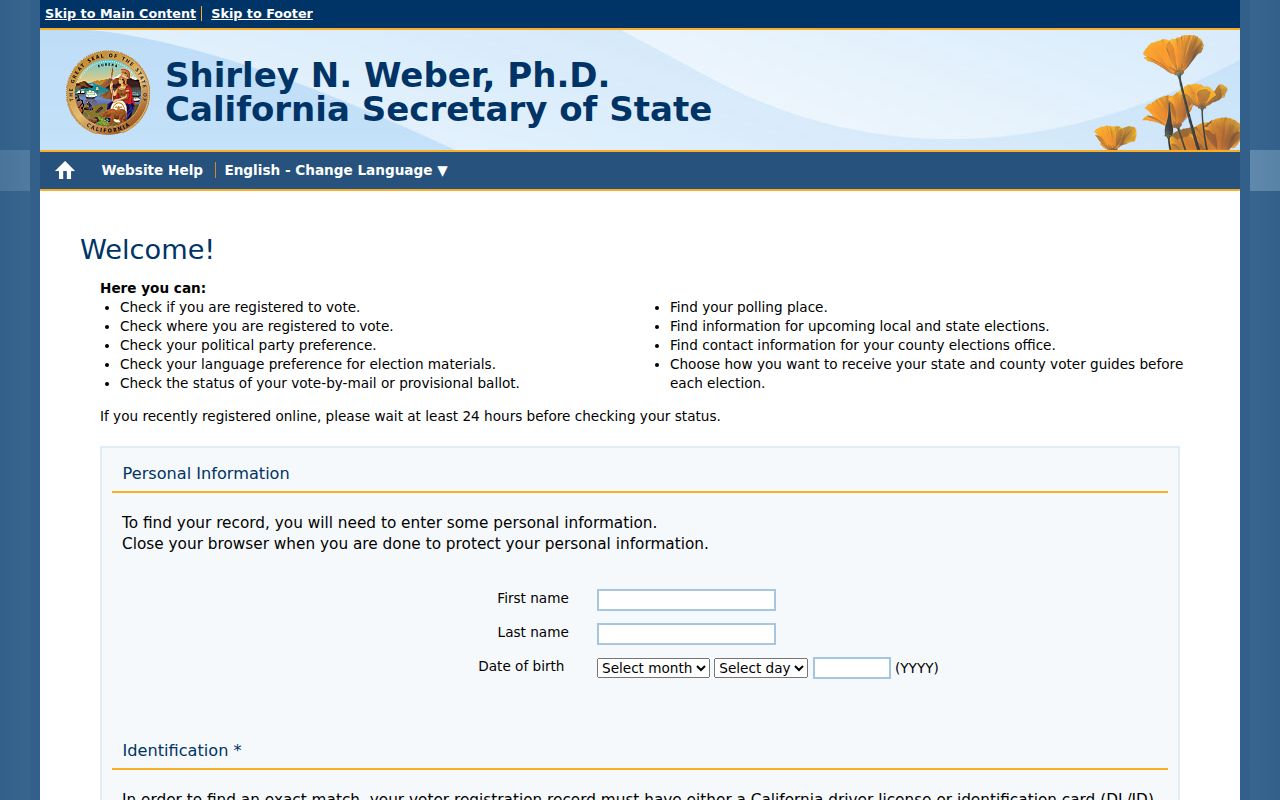
The identity fields narrow access to the voter’s own record and keep protected identifiers out of the result. Safe at Home participants may register confidentially, so a missing or substitute address can be a safety feature rather than an error.
Belmont Court and Vital Record Trails
Belmont has no separate municipal court. Local trial matters belong to San Mateo Superior Court, whose Odyssey Public Portal and MIDX routes cover nonconfidential records in the available case categories. A party name can reveal a caption, role, filing date, case type, status, events, hearings, and public dispositions. Sealed, confidential, juvenile, adoption, paternity, and mental-health matters are not open through the online search. The California Courts lookup guidance points users to the county court because there is no single statewide trial-party index.
Vital records also divide by event and custodian. The San Mateo County Recorder supplies county births and deaths and public marriages. The County Clerk handles confidential marriages. The court holds divorce decrees, while the state may supply a certificate of record for periods it maintains. California distinguishes authorized certified copies from informational certified copies under Health and Safety Code sections 103525 and 103526, and confidential marriages remain restricted under Family Code section 509. CDPH forms and current fees must be checked when a copy is requested.
These records verify an event or court role, not a full current household. The date and eligibility class matter. A certified document should be requested from the custodian that issued or holds it, not inferred from a directory result.
Official Rolls and Commercial Compilations
Commercial people-finder tools can combine public, licensed, and purchased data, but a compiled hit may be stale, merge two people, or omit a protected address. Official sources are narrower, yet their narrowness is useful: each result tells you what role the person or parcel has in that record. A fair comparison keeps cost and authority separate.
| Source type | Strength | Limit |
|---|---|---|
| County assessor or map | Stable parcel and APN key | Does not list every person at the parcel |
| Recorder index | Recorded party, instrument, and date | Online images are excluded; party is not occupant |
| State or court record | Defined identity, event, or case role | Eligibility and confidentiality rules apply |
| Commercial compilation | May suggest a lead across many sources | Accuracy, coverage, cost, and lawful-use limits vary |
Lawful personal use. Belmont records are available for legitimate research, family history, civic understanding, and similar lawful purposes. Do not use a lookup to stalk, harass, intimidate, or harm anyone. Privacy protections and custodian rules still apply to public information.
Belmont Licenses and Business Filings
A professional license or business filing can confirm an affiliation without proving a private residence. California Department of Consumer Affairs search fields include board or bureau, license type and number, business name, first name, last name, and registry number. Secretary of State bizfile can search an entity name or file number and return formation, status, jurisdiction, agent, address, due-date, and filing information. A county fictitious-business-name record may add a local trade name. Each entry must be read for its business role and date.
The California Controller’s unclaimed-property search can connect a name to a city clue, but a claim still needs evidence. State custody and offender tools have their own limits and legal warnings. A license, entity, claim, or registry hit should be used as a lead to the issuing office rather than folded into a private resident roster.
The California Department of Consumer Affairs search shows the professional-license route.
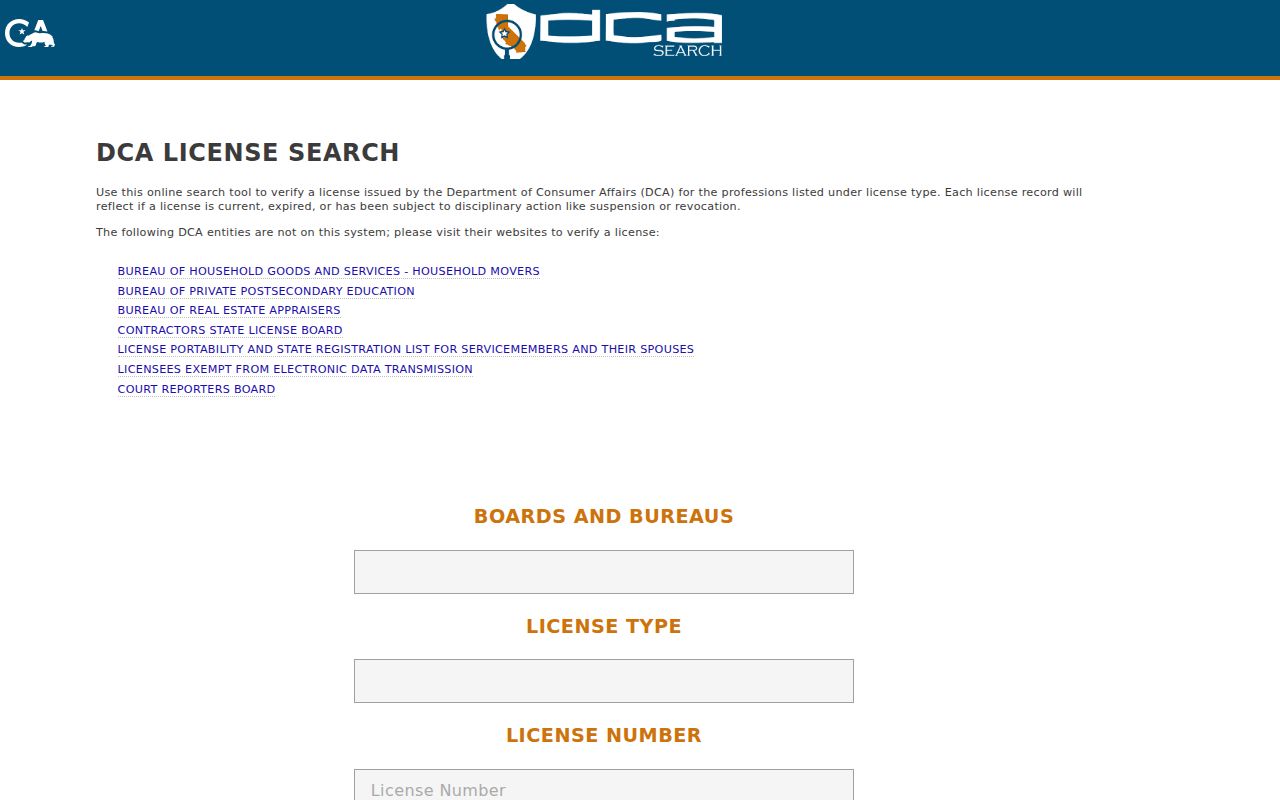
Its board-specific results are more precise than a general name list, but they remain professional records. For an entity question, the California bizfile search provides a separate trail.
The two state systems answer different questions and should not be treated as interchangeable evidence of where a person lives.
Historical Belmont Resident Directories
The historical Belmont residents directory is a group of uneven volumes rather than a continuous annual set. Documented holdings include the Belmont Social Directory from 1899, a San Mateo County city directory for 1911-1912, Polk’s Redwood City volumes for 1941-1942, 1950, and 1954, a 1948 county telephone directory, and an Atherton & Belmont City Directory from 1954. Catalogs also show other county images for 1927, 1945-46, 1948-49, 1955-56, and 1968. The California State Library catalog and local shelves must be checked volume by volume.
An alphabetical entry may show a surname, given name or initials, spouse, occupation, residence marker, address, widow notation, business address, or telephone. A reverse or criss-cross section, when present, runs from street and house number to a listed subscriber. The annual abbreviation key matters. Absence from a volume does not establish a move, death, or complete household change.
Belmont Library, the San Mateo Main Library California Collection, the Schellens abstracts, the San Mateo County Historical Association, and the Belmont Historical Society each fill a different gap. The full shelf map and household-tracing workflow belong on the Belmont city directory collections page.
Records from before Belmont
Older Belmont searches can fail because the place name changed. Research may use The Corners, Four Corners, Angelo’s Corners, Waterview, or Flashner’s Corners. Old County Road aligns with present El Camino Real, while Cañada del Diablo roughly follows Ralston Avenue. Belmont’s post office dates to 1854 and the city incorporated in 1926. For a pre-1856 land trail, the search crosses Rancho de las Pulgas material, federal confirmation, earlier San Francisco County evidence, and then San Mateo County records.
The local history behind those names is more than decoration. A deed, newspaper, directory, or census entry may use an older label even when the modern researcher knows only Belmont. Keep the wording found in the source, record the date, and bridge it to the APN or legal description before treating two entries as the same place.
Definition box. A roll is a maintained list for a defined public purpose. An index points to a record but may not include its image. A parcel is a mapped unit of land identified by an APN. A criss-cross directory reverses the usual name-first order and begins with a street address.
Privacy Choices for Belmont Records
California privacy rules affect both the source records and the data assembled around them. The California Consumer Privacy Act can support access, correction, deletion, and opt-out rights for covered data, but it does not erase a government deed, court file, or assessment record at the source. Safe at Home provides substitute address and confidential mail-forwarding protections for qualifying participants and supports confidential voter registration.
California’s DROP system opened in 2026 for deletion requests sent to registered data brokers. Broker processing begins later in 2026, and status can take time. DROP is different from a request to a county custodian. It may reduce a broker’s copy while leaving the original record with the recorder, court, assessor, or election office. A mistaken official record must be corrected with the office that created it.
The California Megan’s Law site is a separate, restricted-use registry rather than a general resident directory.
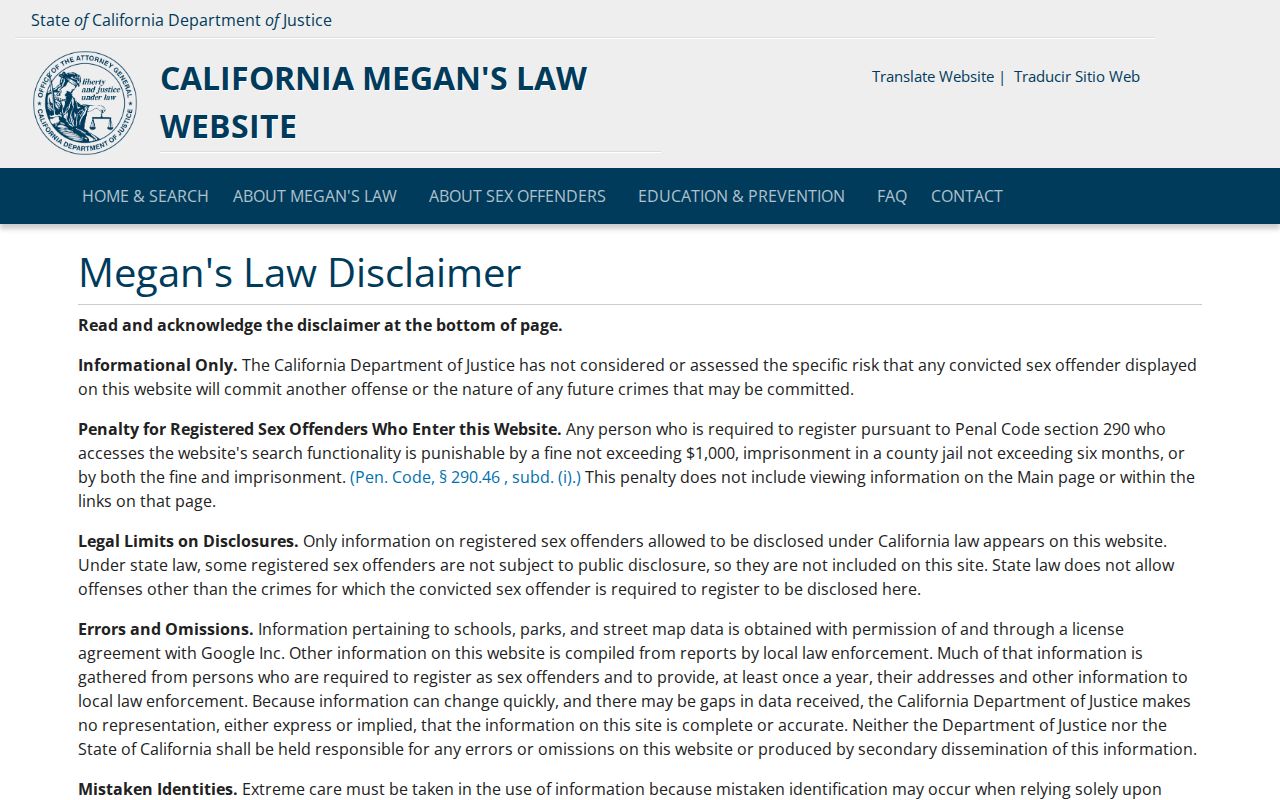
The registry warning and statutory limits matter. A public result never grants permission to threaten, follow, or expose a protected person.
When a Belmont Search Needs a Request
Not every record is online, indexed by name, or open to the general public. A focused request under the California Public Records Act, Government Code sections 7920.000 through 7931.000, can ask a city or county agency to locate an existing, identifiable record. Agencies generally make an initial determination within ten days and may extend that determination by up to fourteen days for unusual circumstances with written reasons. Inspection is ordinarily free, while duplication or special electronic production can carry direct-cost charges.
Write the office, record type, date range, department, address or case number, and preferred inspection or copy method. Belmont’s GovQA channel is the municipal fallback. ACRE, the court, CDPH, the elections office, and state departments each keep separate request channels. The most reliable residents directory result is sometimes a clear statement that the record is restricted, not found, or held elsewhere.
Good research preserves that boundary. Use public information for lawful personal purposes, verify material facts with the custodian, and avoid turning a narrow record into a claim about an entire household.